
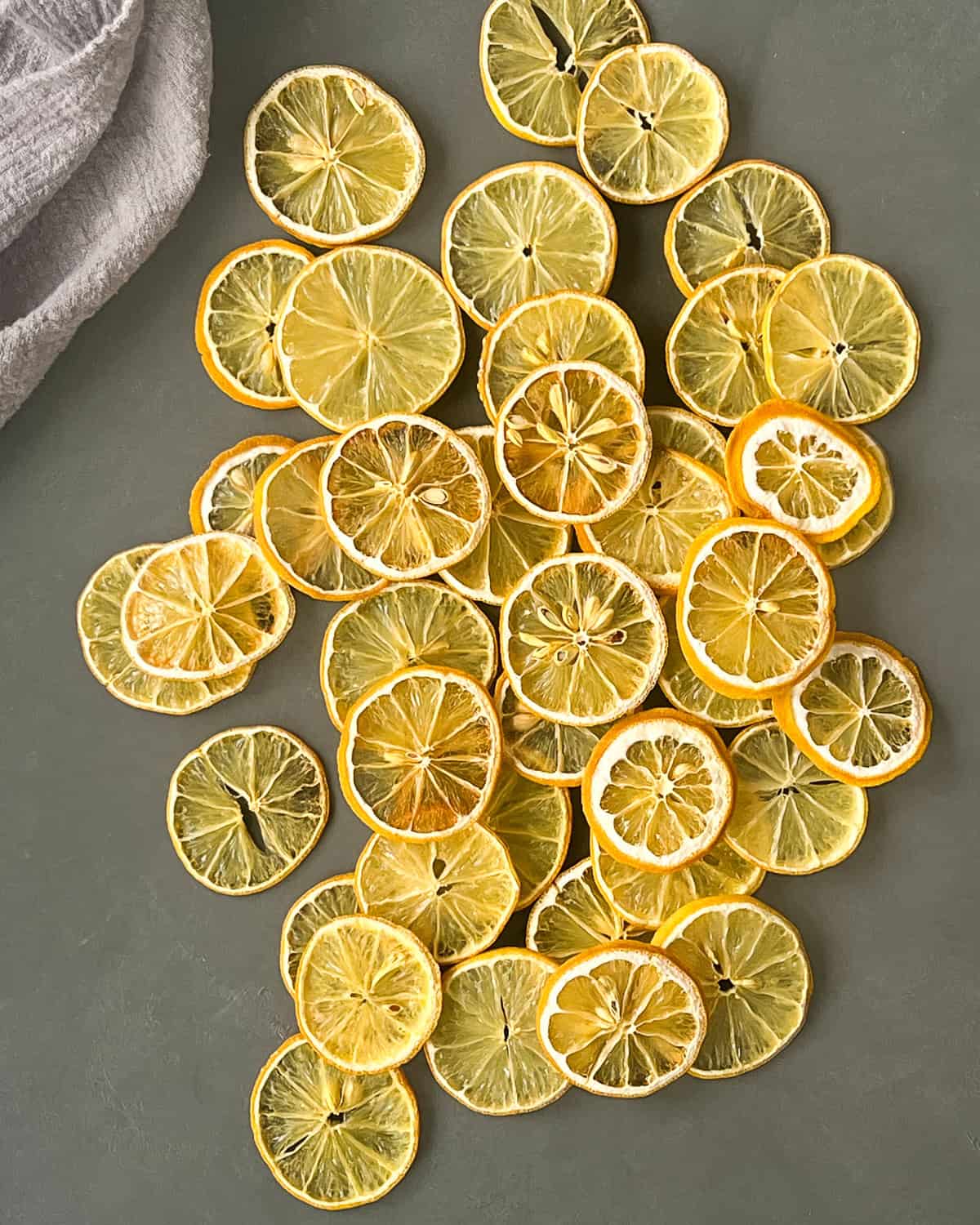
These dried lemon slices are an easy way to turn fresh lemons into a bright, beautiful garnish for drinks, desserts, and more. All you need is your oven (no dehydrator required!) and a little patience for perfectly dried lemons every time!
If you enjoy preserving fruit at home, try my Oven-Dried Apple Slices without a Dehydrator next.

I love keeping a jar of these dried lemon slices on hand because they instantly make simple drinks and desserts look a little extra fancy! I use them to dress up drinks like my Refreshing Coconut Water Mocktail, pair them with my 3-Ingredient Lemon Simple Syrup, or use them to decorate my Vegan Lemon Olive Oil Cake for a pretty citrusy finish.
Quick Look: Dried Lemon Slices
- ⏱ Prep Time: 10 minutes
- ♨️ Drying Time: About 3 hours
- ⏳ Total Time: 3 hours, 10 minutes
- 🔪 Slice Thickness: About ⅛ inch for even drying
- 🌡️ Oven Temperature: 170°F to 200°F
- 🟡 Yield: About 25 slices
- 🍋 Flavor Profile: Bright and citrusy
- 👌 Difficulty: Easy and beginner friendly
- ✨ Ready When: Completely dry with no soft or tacky centers
SUMMARIZE & SAVE THIS CONTENT ON
Jump to:
- Quick Look: Dried Lemon Slices
- Why You’ll Love This Recipe
- Ingredient Notes
- How to Make Dried Lemon Slices in the Oven
- How to Tell When Dried Lemon Slices Are Done
- Common Mistakes (and Fixes)
- How to Dry Lemon Slices in Humid Weather
- Dried Citrus Variations
- Storage
- Dried Lemon Slices FAQs
- More Easy Lemon Recipes
- Dried Lemon Slices Recipe
Why You’ll Love This Recipe
- Bright citrus flavor: Drying concentrates the fresh, tangy lemon flavor into every slice.
- Easy and convenient: Make dried lemon slices right in your oven with no dehydrator needed, then keep a batch on hand for an easy make-ahead garnish.
- So versatile: Use them to garnish mocktails and teas, decorate desserts, infuse drinks, or make a festive dried citrus garland.
Ingredient Notes
Fresh lemons: I recommend Meyer or Eureka lemons for the best results. Choose firm, fresh lemons with smooth, unblemished peels. Lemons with less white pith tend to taste less bitter once dried. You can remove visible seeds after slicing for a cleaner-looking garnish, but it’s not necessary.
Using organic vs. non-organic lemons? Organic lemons are a great choice when you can find them, especially since the peel stays on. Whether you use organic or conventional lemons, wash and scrub them well before slicing to remove any dirt or surface coating.
How to Make Dried Lemon Slices in the Oven
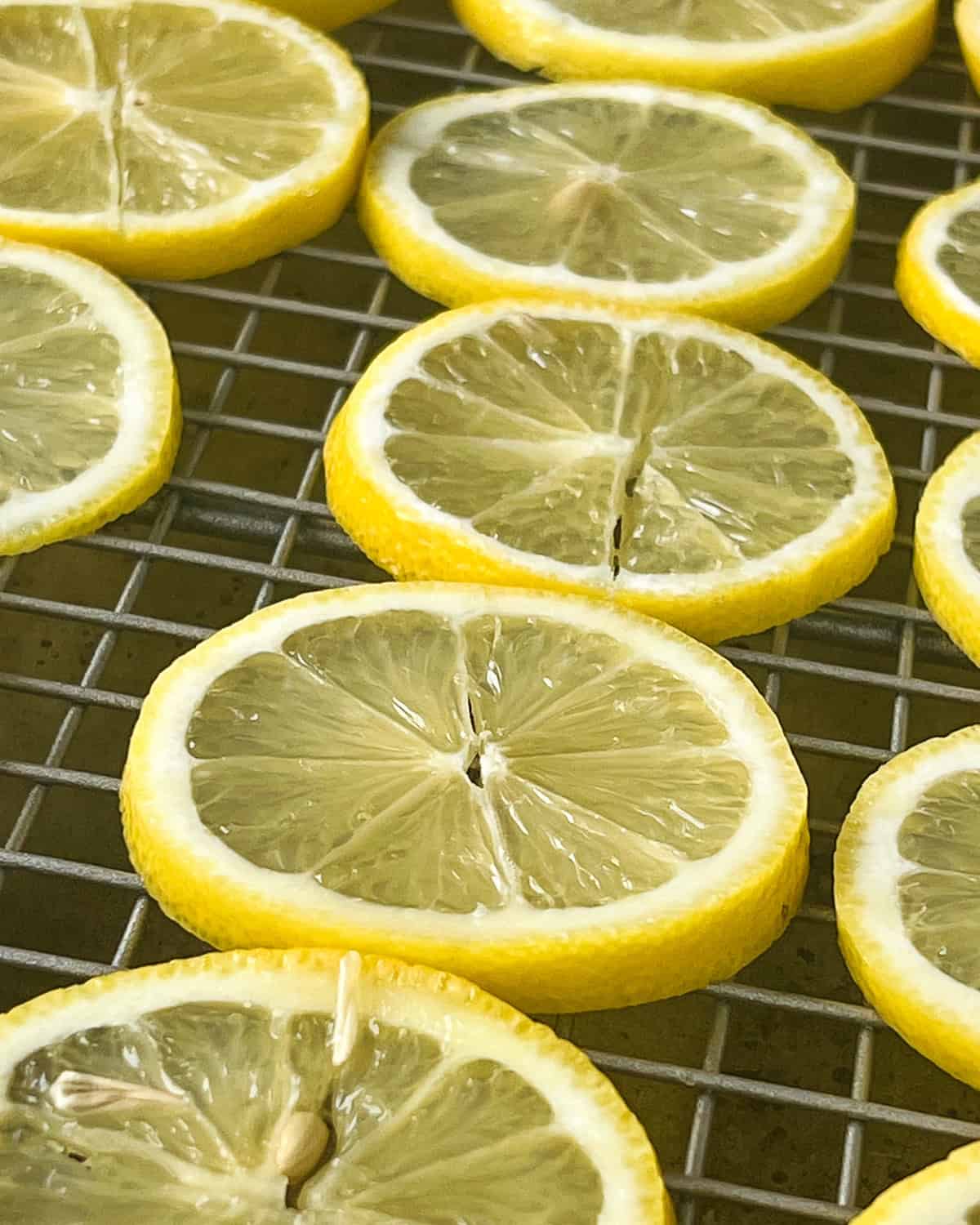
Step 1: Wash and dry the lemons, then cut them into even ¼-inch (6 mm) slices using a sharp knife or mandoline. Keeping the slices uniform helps them dry at the same rate.
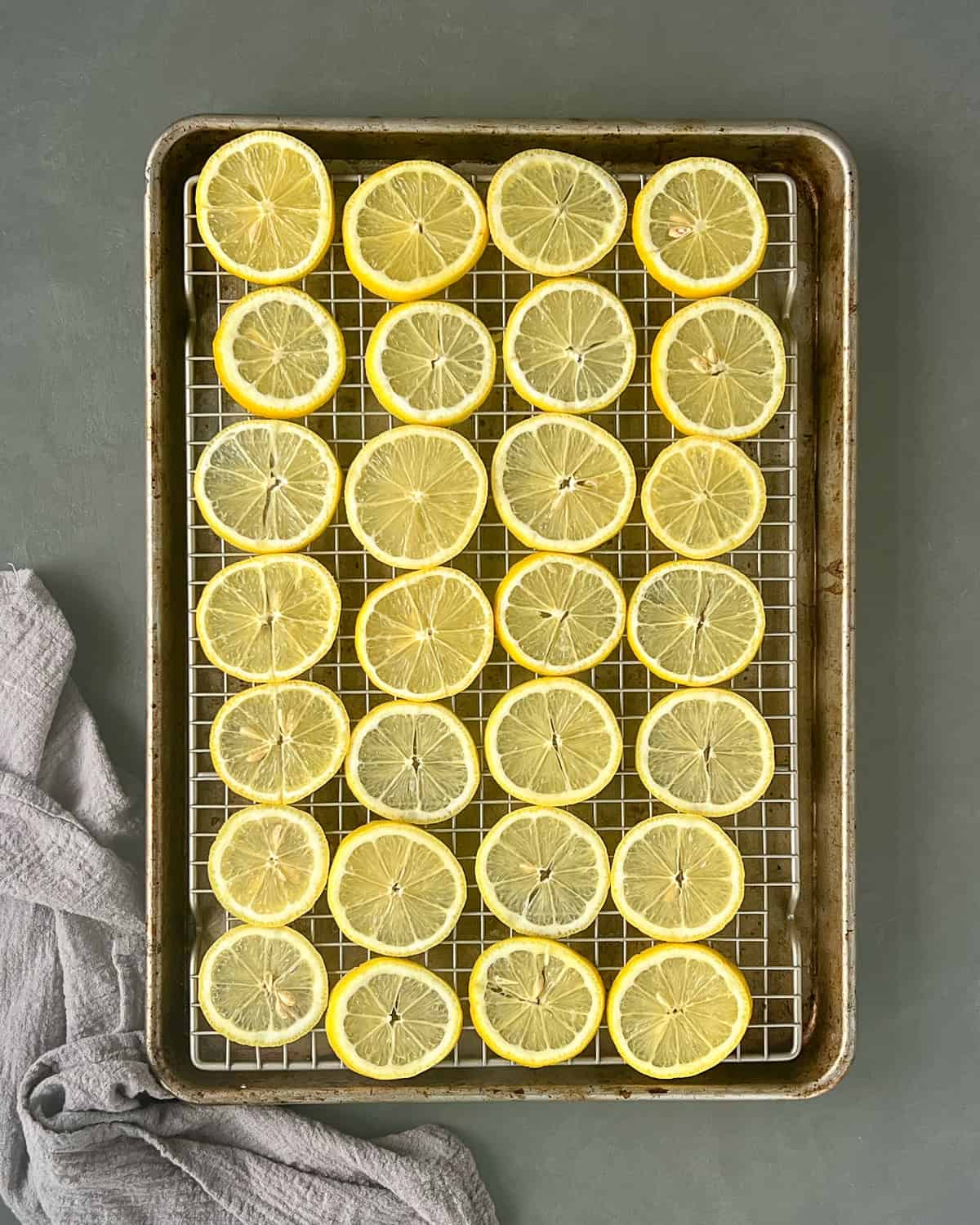
Step 2: Place a cooling rack over a baking sheet and arrange the lemon slices in a single layer without overlapping. I prefer a cooling rack because air can circulate around both sides of the slices for more even drying.
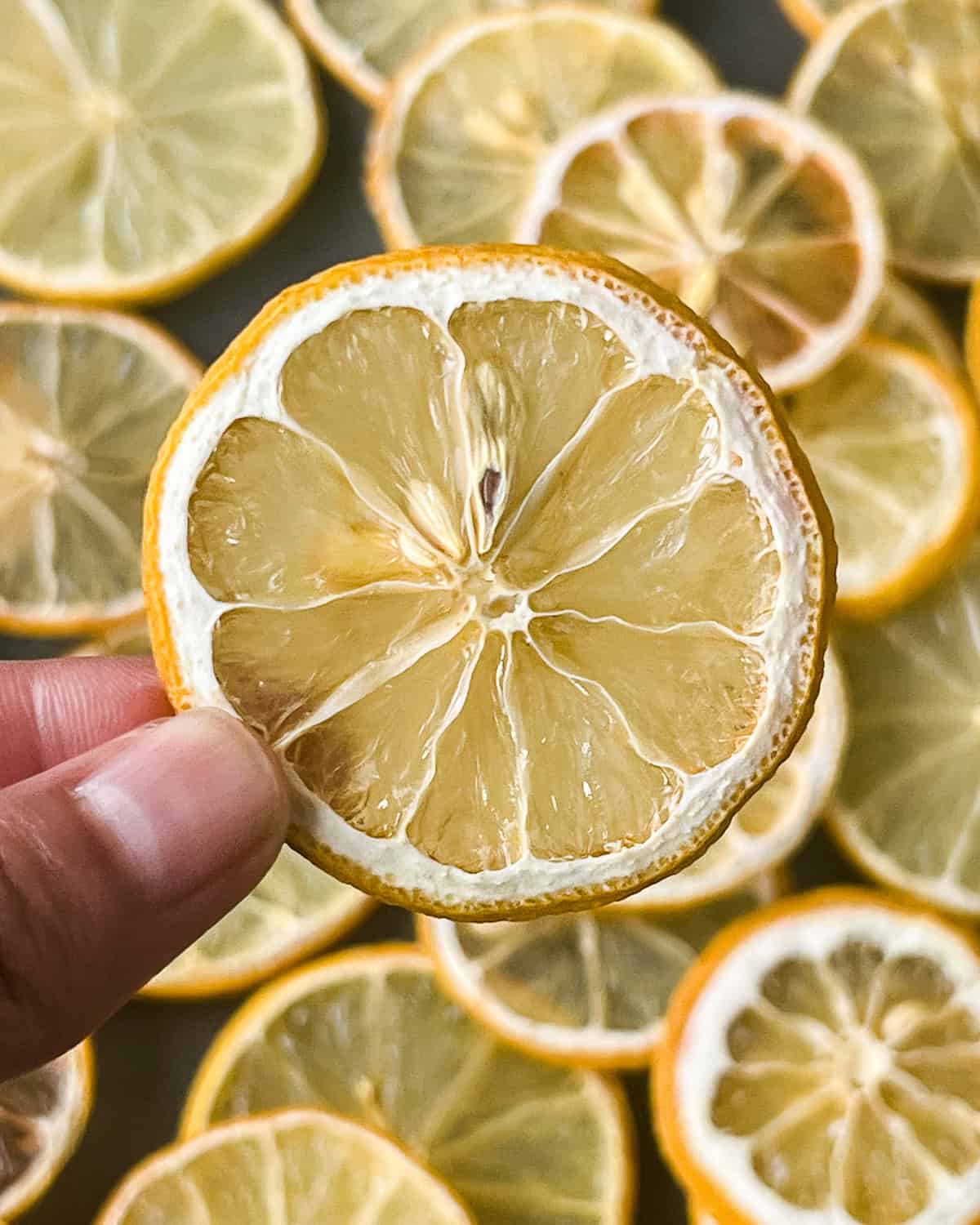
Step 3: Dry at 200°F for 2 hours. Flip the slices, rotate the baking sheet, and continue drying for about 1 more hour. Start checking during the final hour and remove individual slices as they finish, since thinner or smaller slices may dry faster.
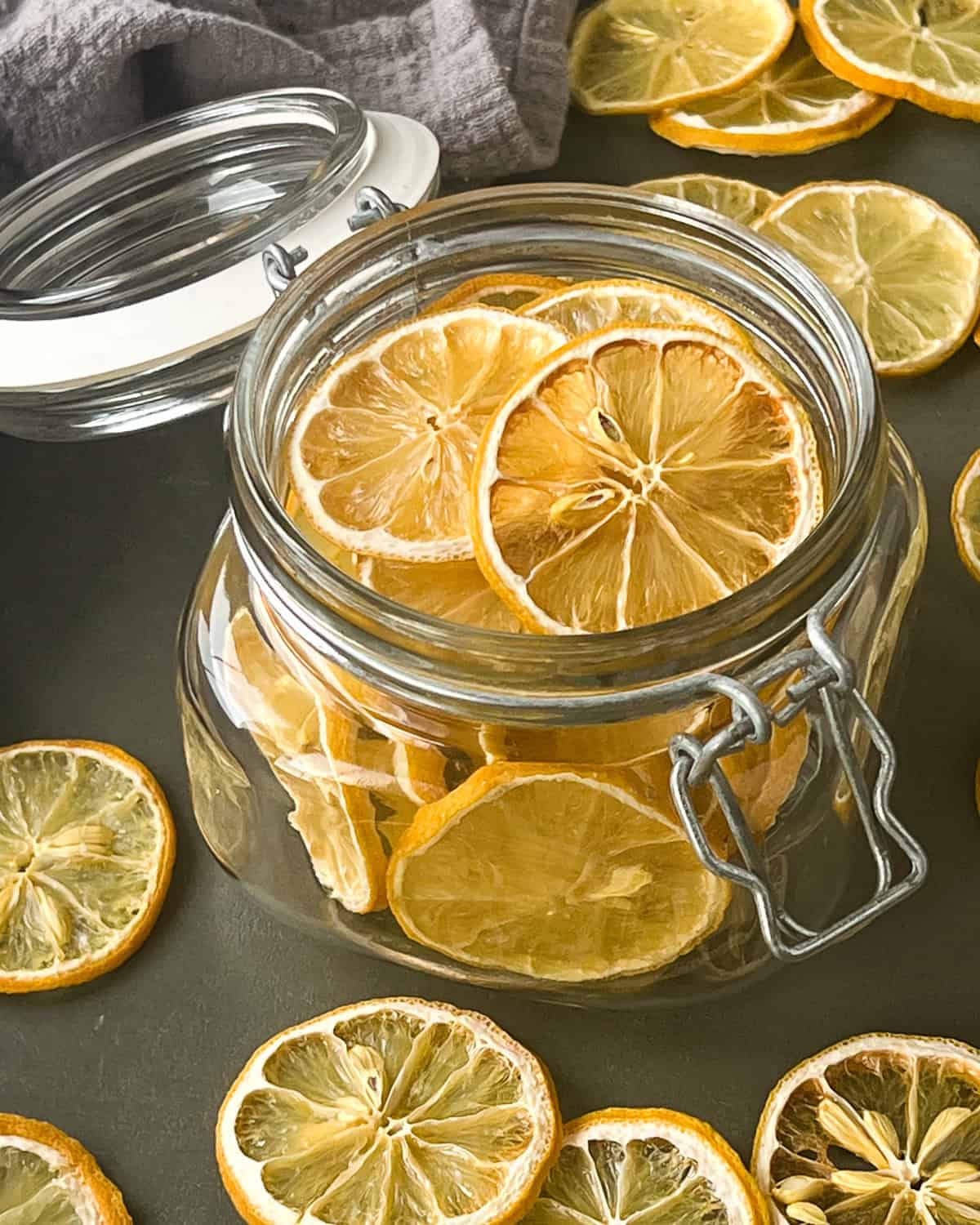
Step 4: Transfer the dried lemon slices to a cooling rack and let them cool completely. I like to leave mine uncovered for 6–8 hours before transferring them to a jar for conditioning.
How to Tell When Dried Lemon Slices Are Done
Dried lemon slices are done when they feel dry to the touch with no soft, sticky, or moist spots in the center. Let a slice cool before checking, since it will firm up and become slightly crisper as it cools.
- Check the center: It should feel dry rather than tacky or moist.
- Look at the edges: They may curl slightly and deepen in color as the slices dry.
- Test the texture: Thinner slices will be crisper, while thicker slices may remain slightly flexible even when fully dried.
Pro Tip: If some slices finish before the others, remove them individually and return the rest to the oven. Lemon size, slice thickness, humidity, and oven temperature can all affect the total drying time.
Common Mistakes (and Fixes)
- Dried lemon slices are turning brown: The oven may be too hot or the slices may have dried too long. Lower the temperature and remove finished slices early to help preserve their bright color.
- Slices are dry around the edges but moist in the center: They may need more time in the oven. Continue drying at a low temperature until no sticky or moist spots remain.
- Moisture appears after storing: The slices may not have been completely dry before sealing. If you notice condensation but no spoilage, dry them again before storing. Discard any slices that show mold.
How to Dry Lemon Slices in Humid Weather
Humidity can make lemon slices take longer to dry because moisture evaporates more slowly. Keep the oven between 170°F and 200°F and allow extra drying time as needed, using the doneness cues above rather than relying only on the clock.
Pro Tip: If the slices still feel tacky after cooling, return them to the oven until fully dry.
Dried Citrus Variations
You can use the same low-and-slow oven method to make other dried citrus slices, including oranges, limes, grapefruit, and blood oranges. Drying time may vary depending on the fruit's size, moisture content, and slice thickness.
- Dried orange slices: Sweet and festive for holiday drinks, desserts, or as a garnish for a Cranberry Orange Mocktail.
- Dried lime slices: Bright and tangy, perfect for garnishing sparkling water, tea, and other refreshing drinks.
- Dried grapefruit slices: Bittersweet and colorful for mocktails, sparkling drinks, or dessert garnishes.
- Dried blood orange slices: Deeply colored and especially pretty for holiday drinks, dessert boards, and seasonal decorating.
You can also pair the different citrus varieties with flavored syrups, like my Homemade Orange Simple Syrup.
Pro Tip: Larger or juicier citrus slices may need more time in the oven, so use the same doneness test rather than relying on the clock.
Storage
Store completely cooled dried lemon slices in a clean, airtight container in a cool, dark, dry place. When properly dried and stored, dried fruit can generally keep for about 4 months to 1 year, depending on temperature and storage conditions.
- Condition before long-term storage: Loosely pack the cooled slices in a glass jar for 7–10 days, shaking daily and checking for condensation. I like glass jars because they make it easy to spot any moisture.
- Watch for moisture: If condensation appears but there are no signs of spoilage, dry the slices again before repackaging. Discard any slices that develop mold.
- For humid climates: Refrigerating or freezing well-packaged dried lemon slices can help maintain quality and limit moisture exposure.
Dried Lemon Slices FAQs
Yes. Dried lemon slices are edible, including the peel, but the white pith can give them a slightly bitter flavor. They can be used in drinks, teas, desserts, or as an edible garnish.
Yes. Arrange the lemon slices in a single layer and follow your dehydrator manufacturer's recommended temperature and drying time for fruit. Dehydrators generally use lower temperatures than ovens, so drying may take longer.
Yes. Grind completely dried lemon slices in a spice grinder or high-powered blender until fine. Use lemon powder to flavor baked goods, dressings, seasoning blends, tea, or lemon sugar.
Yes. Soak dried lemon slices in warm water until softened. Rehydrated lemons can be added to drinks or chopped and used in recipes where a softer texture is preferred.
More Easy Lemon Recipes


If you tried this Dried Lemon Slice recipe or any other recipe on my blog, please leave a 🌟 star rating and let me know how it goes in the 📝 comments below.

Dried Lemon Slices Recipe
DESCRIPTION
EQUIPMENT
- Sharpe knife or mandoline slicer to slice lemons evenly
- Baking sheet to prevent lemon juice from dripping in the oven
- Wire Cooling Rack (Oven-safe) to allow air circulation and speed up drying
- Kitchen towel to use when cooling off dried lemons
INGREDIENTS
- 4 whole lemons (unwaxed) Recommended brands: Meyer or Eureka
METHOD
Preheat and Prep
- Preheat oven to 200℉.
- Place a wire cooling rack inside a baking sheet.
Wash and Slice
- Wash and thoroughly dry the lemons.
- Slice clean lemons into ¼ inch thick rounds using a mandolin or sharp kitchen knife. Note: I prefer using a mandolin for even slices.
- Optional: Remove visible seeds if using slices for tea/flavor infusions.
Arrange
- Lay slices on the rack in a single layer without overlapping.
Dry Low and Slow
- Dry in the oven for 2 hours.
- Then remove from oven to flip each slice, rotate the baking sheet 180°, and place back in the oven at 200℉. Dry for 1 more hour.
Check Doneness
- Slices are done when translucent, firm, and non-sticky.
- Place soft or damp slices back in the oven, and continue drying in 15-minute intervals.
Air-out and Store
- Let slices air dry at room temperature for 6-8 hours over a kitchen towel.
- Store in an air-tight glass jar in a cool, dark place. Shake daily during the first week to keep slices separated.
NOTES
-
- No overlapping: Arrange the slices in a single layer on the pan for proper air circulation.
-
- Convection: If your oven has a convection setting, I recommend using it. This setting turns on a fan that helps circulate air more evenly.
-
- Flip the slices: To prevent uneven drying, flip the slices around the two-third way mark. This also gives you a chance to rotate the pan since some ovens have hot spots.
- Remove moisture completely: To ensure all moisture is gone, make sure to air out the dried lemon slices for 6-8 hours before storing.
- Conditioning: After storing, shake jar for 5-10 days daily to equalize any remaining moisture, prevent mold before sealing them for longer storage.


Alison says
First-timer here - recipe was good, great results thank you. 95 degrees celsius equivalent worked well, extended the time by a few extra 15 mins for the larger segments.
Puja Verma says
Thank you so much, Alison! 😊 I'm so glad it turned out well for you, especially on your first try! Thanks for sharing the Celsius conversion and your timing adjustment too. Larger lemon slices definitely need a little extra time, so I'm sure that'll be helpful for other readers. Happy dehydrating! 🍋💛
nienke says
my oven can do either 70C (158F) or 100C (212F), I think I'll risk 100C but keep a good eye on them, and lower things to 70C either if I see any signs of browning or towards the end when it's already fairly dry
Puja Verma says
I’d actually recommend using 70°C (158°F) if those are your two options. 😊 My recipe calls for 170°F–200°F (about 77°C–93°C), so 100°C (212°F) is a little higher and may cause the lemons to brown before they’re fully dried. At 70°C, they’ll likely just need some extra drying time. Keep an eye on them toward the end and remove any smaller slices as they finish. Hope they turn out beautifully! 🍋
Nienke says
thanks, I tried a bit of both, indeed at 100C they ended up slightly browning (likely caramelising) which also changed the flavour in a way I didn't particularly enjoy, but at 70C it seemed like they didn't dry to the desired extent, but maybe I was just too impatient. I might try again sticking to just 70C with longer drying times if I have some more leftover citrus and some time to engage in this. ^_^
T. Dingman says
dehydrated lemon slices. I just returned from Budapest, Hungary where luminaid is a national icon.. In a good restaurant (where you will pay for water at the table) you may verywell find a thin slice of dehydrated lemon at the empty bottom of the glass before they pour.
Puja Verma says
Ooo!! Thank you for sharing this information about Hungary. Next time I serve fancy, I'll have my guests find a thin slice of dried lemon at the bottom of their serving glass before I pour in the water.